
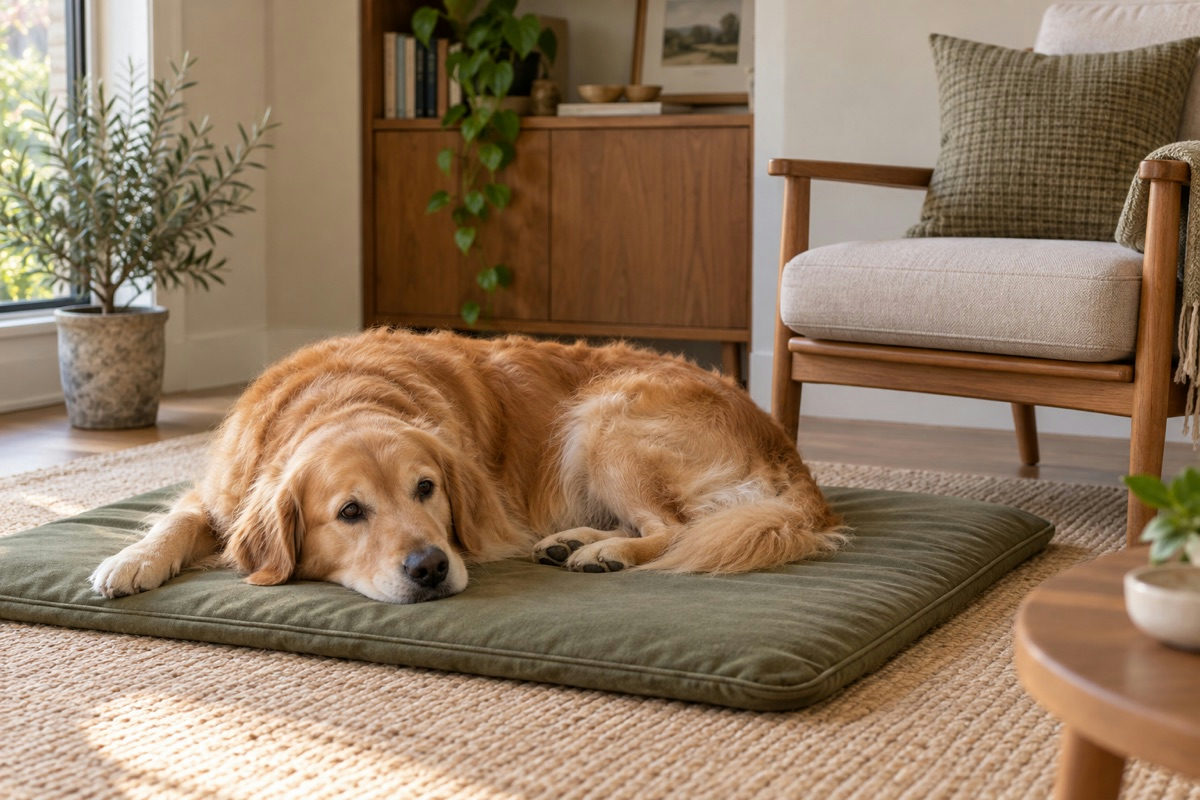
A Retriever Settle Mat can give quiet practice a recognisable place in your home. The useful part is the whole setup: a calm corner, room to lie comfortably, predictable movement from you and an easy starting task. Buying a mat alone does not teach a dog to relax around guests or a busy kitchen.
Dogs Trust’s settling guidance starts in a quiet place and rewards relaxed behaviour before adding distractions gradually. This guide focuses on preparing that place and keeping an observation record. The room layouts are examples you can adapt; they are not a promise that every retriever will settle on a set timetable.
By Retriever Dogs Guide Editorial. This is general training information, not veterinary advice. If your dog cannot rest, seems uncomfortable or has a sudden change in behaviour, seek appropriate veterinary or qualified behaviour support.
Decide what the corner is for
Choose a modest first purpose: quiet time beside you in a familiar room. Keep it separate from training a long stay, leaving the dog alone or managing a full house of visitors. Those situations have extra demands. A clear purpose makes it easier to notice whether the setup is helping your current practice.
Write a sentence you can use in your notes: “I will sit beside the mat while the room is quiet.” This describes your part of the session as well as the dog’s space. If you instead write “make the dog calm”, there is no practical detail to reproduce and no clear way to judge which feature changed.
Look at your daily routines and select a time when the room is usually less busy. Avoid the moment when everyone is leaving, food is arriving or children are starting a game. You do not need a perfect house. You need a starting situation that is simple enough to observe without constant interruptions.
Place the Retriever Settle Mat with room around it
Lay the mat where your dog can approach, turn and move away without squeezing between furniture. Put it clear of a door swing and a main route through the room. Check it from the dog’s level as well as while standing. A chair leg or low shelf can make an apparently open patch cramped.
Choose a surface that lies flat and suits the floor. Watch for folds, a sliding underside or edges that curl as you sit down. Do the first placement check without the dog. Walk around the corner, move your chair and make sure your feet will not catch the mat each time you reach for supplies.
For a Golden Retriever, pay attention to the usable resting area rather than the size printed on a package. Mark the mat’s outline on the floor with a temporary visual guide if you are comparing sizes. Observe the space your dog uses when resting elsewhere. Do not ask them to remain neatly inside a rectangle that is too small.
Arrange your seat and supplies
Put your chair where you can sit comfortably without leaning over the dog. Test the space for your knees, feet and reward container. If you have to stand up for each reward, move the container. If it is so close that the dog can help themselves, place it somewhere reachable to you but outside their access.
Keep the first setup plain. Remove squeaky toys from the immediate area and pause any unrelated handling task. A mat beside a brush, nail tool and noisy vacuum creates several possible reasons for the dog’s response. You will learn more from the quiet version before introducing any of those objects separately.
If a training professional recommends a lead for a particular exercise, ask them to show you a suitable arrangement. Do not tie the dog to furniture, stand on the lead or tighten it to force a position. This corner should offer a comfortable resting opportunity, not become a makeshift restraint station.
Observe before asking for a position
Let your retriever investigate the mat and the surrounding space. Notice whether they sniff, stand nearby, sit, lie down or leave. Write down the visible action. Do not assume a dog that stands still is relaxed, or that a dog lying down is automatically ready for a busy café.
Use the linked Battersea settling resource for the broader distinction between practising calm behaviour and repeatedly asking for attention. In your home notes, record whether your own talking, hand movement or reward preparation makes the dog become more focused on you.
A quiet observation can reveal a simple layout problem. For example, the dog may keep moving because your chair blocks their preferred resting side. Try moving the chair for the next practice rather than insisting on a position. Keep the mat and room the same so you can see whether that single change matters.
Keep reward placement deliberate
Before practising, choose how you will place a suitable reward without making a large gesture. Keep the movement low and predictable. If you are constantly waving food overhead, the session may become an attention exercise rather than the quiet activity you intended. Review the mechanics of your hand movement first.
Use food consistent with your dog’s existing care plan. Ask your veterinarian about individual food or intake questions. You do not need a new recipe for this exercise, and this guide does not set a treat allowance. Your notes should describe the reward type so another handler knows what was actually used.
Do not combine a new reward, a new mat and a new room on the same attempt. If the dog becomes occupied with chewing the mat or searching your pockets, pause and simplify the picture. Record the event without labelling it as failure. The information may point to a clearer setup for next time.
Add household movement in small steps
Start with a pretend version of an everyday activity. A helper might stand up from a distant chair and sit down again, while the rest of the room stays quiet. Describe the movement before you begin. “Person stands near the window” gives you a repeatable example; “add distractions” does not.
Keep the helper briefed. Ask them not to call the dog, carry food or start petting during the test movement. Those are different changes. If the dog gets up, notice the point at which it happened and make the next version easier. Do not immediately repeat the movement more quickly to test obedience.
Build a list of everyday changes separately: a cupboard door, a person crossing the room, a coat being lifted or a quiet conversation. Choose one for a practice. Save busier situations for a later stage with appropriate guidance. A calm response in the living room is only evidence about that living-room setup.
Write notes that help the next handler
Use headings for location, mat position, your position, activity and observed response. An entry might say: “Mat beside sofa; chair at left edge; no helper; dog lay on hip after investigating.” Another might read: “Helper walked past doorway; dog stood and followed; next time move helper farther away.”
Include your own movements. Did you reach for a cup, speak to someone or move the reward container? These details can explain differences between sessions. Keep the language concrete. “Looked toward kitchen after drawer opened” is more useful than “very distracted today”, because it identifies the event to simplify.
Keep a single current page in the working area. Store earlier notes together if you want the history. That avoids one person using yesterday’s plan while another introduces a new challenge. A Retriever Settle Mat works best as part of an understandable routine everyone can describe.
Questions before moving to a new place
Can I take the same mat to a café?
The familiar object is one part of the picture. A café adds people, movement, sounds and less control over space. Rehearse an easier new room first and get training help for public settings when needed. Do not treat success at home as permission to expect the same response everywhere.
What if the dog chooses another resting spot?
Check what differs about that location: floor surface, space, temperature or distance from activity. You can learn from the preference and adjust your planned corner. The goal is comfortable quiet practice. The mat’s original position does not need to win an argument.
Keep this plan separate from time-alone guidance, which addresses a different task. Finish by putting away supplies and writing one clear next action. That leaves your next practice with a known room layout and a manageable change to try.