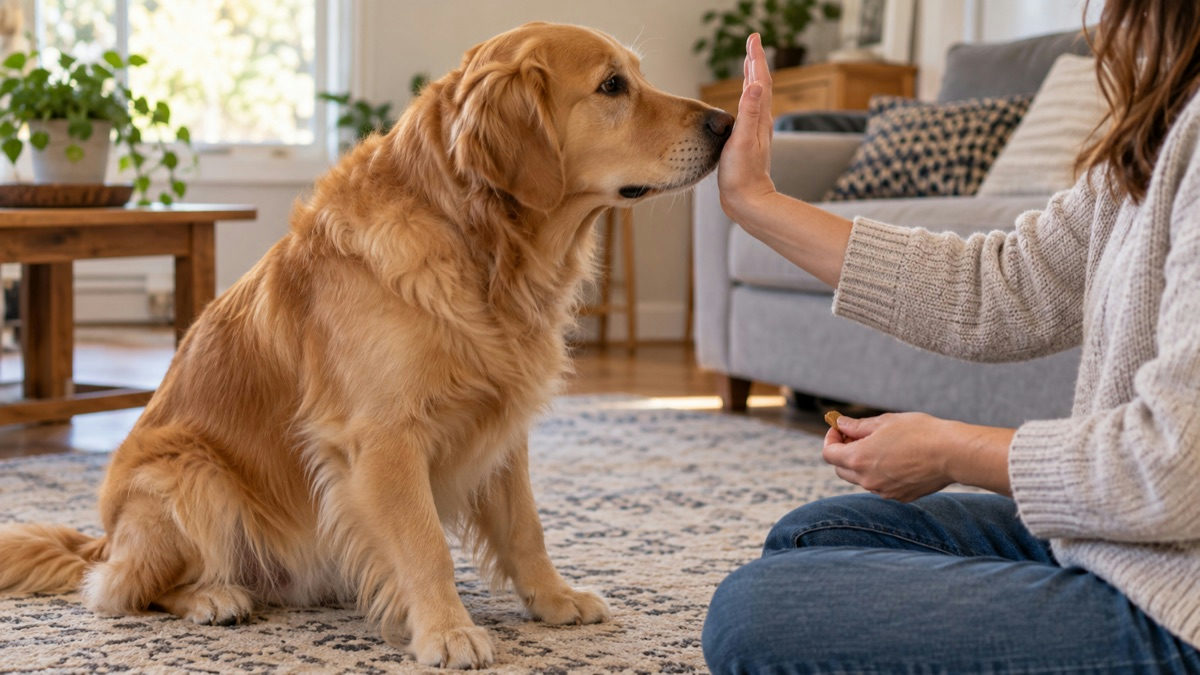
A Retriever Hand Target gives your dog a clear, voluntary destination: your empty palm. It can be useful when you want a small change of position beside a chair, before fitting equipment or during a quiet training game. Start with the nose touch itself. Do not combine it immediately with walking, holding still and ignoring distractions.
This guide separates the training principle from a practical home worksheet. Dogs Trust explains target training as teaching a dog to touch a chosen target, rewarding the contact and building difficulty gradually. The organisation recommends a calm setting and brief, enjoyable practice. The examples below help you organise that approach around your own room, hands and household.
By Retriever Dogs Guide Editorial. This is general training information, not veterinary advice. Ask a qualified reward-based trainer for individual help if handling or proximity makes your dog uncomfortable.
Define the touch you want to see
Write the action in plain language: “Nose meets my open palm, then my hand moves away.” That is a more useful starting description than “listen to me”. It tells you exactly what to notice. A paw landing on your wrist, a lick of a food-filled fist and a nose pressed against your sleeve are different actions.
Choose one target hand for the first practice. Hold it sideways or upright in a position you can reproduce without reaching over the dog’s head. Your palm should be empty. Keep rewards in the other hand or in an accessible container outside the dog’s reach. Decide where you will deliver the reward before you start.
For an adult Golden Retriever, consider your own posture as well as the dog’s height. A stable chair can make a low hand position easier. Avoid leaning so far forward that you lose balance when the dog approaches. The first goal is an easy interaction at comfortable nose height, without anyone stretching awkwardly.
Prepare one quiet practice corner
Use a familiar room with enough floor space for your dog to approach and move away. Put away the ball, close off busy passageways and ask family members to pause their own instructions. Your dog should have an available exit from the interaction. Do not wedge them between your knees and a sofa.
Place your training supplies in the same spot. An empty target hand, a reachable reward container and a simple note sheet are enough. A clicker is optional; a consistent spoken marker can serve as the signal that you noticed the desired action. Choose a word you can say clearly without turning it into a stream of chatter.
Practise your hand sequence without the dog first. Present the palm, say your marker, withdraw the palm and deliver a reward from the other hand. This rehearsal exposes awkward movements. If you keep switching hands or fumbling with a pocket, change the setup before inviting your retriever over.
Watch the first response without chasing
Offer the palm within easy reach. Give your dog space to investigate rather than moving the hand toward their face. Notice what happens: a glance, an approach, a sniff, a nose contact or a turn away. You are gathering information about the starting picture, not testing an obedience requirement.
When you see the nose contact you intended, mark it promptly and reward. Lower the target hand between offers so each presentation has a beginning and an end. Avoid keeping it permanently beside the dog’s muzzle. A clearly presented target is easier for you to track than a hand that stays available through the whole session.
If your dog mouths the hand, paws repeatedly or disengages, pause. Check the setup rather than repeating the gesture faster. Is food hidden in the target palm? Is the hand too high? Are you talking and moving at the same time? Change one feature, then decide whether another easy offer is appropriate.
Add a word when the action is recognisable
Keep a note of when contact begins to look consistent in the quiet corner. You do not need a calendar deadline or a breed-specific number of repetitions. You need to recognise that the dog is approaching the same palm in the same way, while your own reward sequence remains clear.
Select a short cue such as “touch”. Tell the household which word you chose and what it means. Do not use it to mean “look at me”, “come across the garden” and “hold your nose here” simultaneously. Those requests may be useful later, but they create different pictures for a beginner.
Use the cue with the familiar presentation rather than calling it repeatedly from across the room. If the dog does something else, let that offer end and simplify the next one. A cue is information about an available action; making it louder does not repair an unclear hand position or an over-busy setting.
Keep movement separate from duration
A brief touch, a moving target and a held nose contact are separate variations. Decide which one you need. For shifting your dog beside a chair, a small movement toward the palm may be useful. For a cooperative handling exercise, a held position would require its own careful training plan.
Start a movement variation with the hand only slightly to one side of its usual position. Keep the room, reward and your posture familiar. Do not ask for a long walk across the room on the same attempt that introduces a new hand angle. You want to know which change the dog actually understood.
Keep the target within the dog’s comfortable movement range. Never use it to pull them toward something they are avoiding. If the real task involves equipment they dislike, return to an equipment introduction plan with appropriate professional help. A touch cue is not permission to push through discomfort.
Use a simple progress record
Write four headings on a page: location, target picture, observed response and next change. A useful entry might read: “Living room rug; left palm beside nose; contacted after a sniff; repeat same position.” Another might say: “Hallway; palm farther away; looked toward door; return to rug.”
Describe what you saw rather than assigning a personality label. “Walked to the window” is more informative than “stubborn”. “Pawed when food was in the target hand” identifies a setup issue you can change. These notes help another household member reproduce the successful version without guessing what happened.
At the end, choose one next action. Repeat the familiar presentation, change the location slightly or ask a trainer about a recurring difficulty. Avoid adding distance, new people, a busy doorway and longer contact together. A short record is useful only when it leads to a specific, manageable adjustment.
Try an everyday use in an easy setting
Set up a pretend task before using the cue during a real rush. For example, put an empty chair in the practice corner and offer your palm beside it. If the dog approaches comfortably, mark the touch and reward. You have rehearsed positioning without adding visitors, bags or a departing family member.
For a harness setup, keep the equipment nearby but separate from the touch exercise at first. Record whether its presence changes the dog’s response. Do not turn a successful touch into an unexpected fastening procedure. Predictable steps make it easier to distinguish the hand-target lesson from the equipment lesson.
Keep this cue separate from your retriever recall practice. Recall brings the dog back to you; targeting specifies a small destination once they are nearby. A retriever that understands one skill does not automatically understand the other, and neither is a substitute for sensible physical management outdoors.
Common household questions
Can everyone use a different hand?
They can introduce their own target picture, but begin with an agreed version. Write down which palm, approximate position and cue you are teaching. Let a new person practise in the familiar corner before expecting the dog to respond during an everyday task. That keeps the change small and visible.
What if my dog touches only when food is visible?
Check whether the reward hand has become the real target. Keep it still and separate from the empty palm. Review your presentation with a trainer if you cannot tell which movement the dog follows. Do not hide food in the target fist and then assume you have taught an empty-palm touch.
Should I insist when my retriever walks away?
End the offer and review the situation. A voluntary approach is the foundation of this exercise. Make the next practice simpler or pause altogether. Finish with a clear note about what worked so the next session begins with an understandable hand signal and a comfortable choice to engage.